
Composing new music inspired by Silbury Hill by composer Harrison Birtwistle. Playing with ‘musical objects’, exploring tempo, dynamics and articulation.
Birtwistle often describes his musical ideas as ‘objects’ which the listener can ‘view’ from different view points and angles. This is one of many visual analogies he uses to describe his music. He borrows the metaphor ‘taking a line for a walk’ from the visual artist Paul Klee as way to describe his melodies, uses the phrase ‘imaginary landscape’ to describe his music and the metaphor of 'taking a walk around a town' to explain how his music works. These simple, visual analogies are useful for pupils unused to thinking musically/aurally, and offer simple ways to generate and transform musical ideas.
Through a series of composing activities, pupils will work in groups of three to create a musical object consisting of three unison eight-note melodies using given pitches across a narrow register. Once created pupils will apply different techniques and colourations to the musical object in order to present it as if seen from different angles and perspectives.
Pupils will also work in large groups to create rhythmic planes of different speeds, dynamics and articulations. The two ideas will be combined to create a larger composition.
Listen to Silbury Air before starting. NB it starts quietly
Silbury Air is named after Silbury Hill, a prehistoric mound in Wiltshire, the biggest artificial mound in Europe, being 125 feet high and covering more than five acres. Its use and purpose, after centuries of speculation, still remain a mystery. The music of the Air is not in any way meant to be a romantic reflection of the hill's enigmatic location – nor a parallel with any of its evident geometry. Seen from a distance the hill presents itself as an artificial but organic intruder on the landscape. I have often alluded to my music of landscape presenting musical ideas through the juxtaposition and repetition of 'static blocks' or, preferable for my terminology, objects. These objects themselves being subjected to a vigorous invented logic via modes of juxtaposition, modes of repetition, modes of change. The sum total of these processes is a compound artificial landscape or 'imaginary' landscape, to use Paul Klee's title.
Harrison Birtwistle

Composer Harrison Birtwistle often described his melodies as ‘taking a line for a walk’ - a wonderful and useful analogy that can support pupils' imagination. Birtwistle’s melodies also often use a narrow defined pitch range.
You can start this activity in two ways, both working in groups of three. First of all, either give students a narrow pitch range or choose one for them e.g, D to G. Then using the Taking a line for a walk worksheet (download below) either:
Their lines/melodies should move up and down like a line going for a walk. It is important that the groups notes line up vertically. Ask the groups to look at the different ups and downs of their lines and to try and have a mixture going on at the same time i.e. when one line is going up the other is going down (see an example below).


Abstract Trio by Paul Klee, www.metmuseum.org
Listen to BCMG musicians playing the example three lines in turn.
Give pupils time to practise playing their melodies together in rhythmic unison. i.e. each plays their own line but moves in time with the other two children at a constant tempo, one beat per note. These three lines played together are their musical object.
Listen to the BCMG musicians playing the example three lines together in rhythmic unison.
Then ask groups to practise playing their ‘musical object’ at different speeds, dynamics and articulations – this will be helpful for the next activity.
In Silbury Air, Birtwistle is not setting out to create a musical depiction of Silbury Hill. Instead he is using it as curious and mysterious object in a landscape that can be viewed from different perspectives: from afar as a strange unnatural protrusion in the landscape or from close, marveling at its overwhelming size, shape and symmetry. Birtwistle's biographer Jonathan Cross offers this description:
‘As the clouds move across the Wiltshire Plains, the light on the hill always changing; one sees it from ever new perspectives.’
A composing technique Birtwistle uses time and time again in his music is to repeat a musical object (think hill) note for note and create different versions of it that sometimes are heard alone and sometimes simultaneously. Another useful analogy is the cubist paintings of Picasso. Here objects are broken up and instead of depicting the object from one viewpoint, offer multiple viewpoints simultaneously.
Ask pupils to imagine how their ‘musical object’ would sound if:
Pupils will end up with four ways to ‘colour’ their ‘musical object’. As they do this activity ask them to think about tempo, dynamics, articulations and instrumental techniques (muted, plucked, bowed etc.). What is important is that they must not add anything new to their musical objects.
Listen to the BCMG musicians examples:
Close up
Sunny
Distant
Misty
Birtwistle also uses the analogy of ‘walking around a small town’ to describe what he does with a musical idea:
‘Taking a walk through a town—especially the sort of small town more common in continental Europe than Britain. Such a walk might start in the town square. Having explored its main features, we would set off down one of the side streets.
As the walk continues, we might glimpse the town square down different streets, sometime a long way off, other times quite close. We may never return to the square in the rest of the walk or we may visit a new part of it that was not explored initially.’
This metaphor describes the way a core musical idea is altered, varied and distorted as the music progresses. So far, pupils have already created versions that describe different times of day and weather conditions.
Now pupils are going to use Birtwistle’s analogy of walking around a small town to think about how their musical object would sound if viewed through a doorway or between two buildings.
Using two pieces of paper (see photograph) ask pupils to create a doorway which leaves just three or four notes revealed – this is a new version of the musical object. Ask them to practice playing this version – repeating it over and over as an ostinato.

Taking a line for a walk worksheet with doorway
Listen to BCMG musicians play their 'doorway' version as an ostinato.
Update Required
To play the media you will need to either update your browser to a recent version or update your Flash plugin.
Ask pupils to imagine that some of their musical object is being obscured by lampposts or Trees. Using strips of paper (see photograph) put two or three strips over the notes across the whole grid. Where there is now a ‘lamppost or tree’ the children should treat this as a rest/silent beat. This is a new version of their musical object.

Listen to the BCMG musicians play their 'lamppost / tree' version.
Each group will now have three versions of their musical object:
And four ways of ‘colouring’ their object:
Ask each group to chose their three favourite versions, each with its own colouration. Encourage them to choose contrasting ideas, e.g. (a) the doorway version in the distance, (b) the lamppost version close up, (c) the original version.
Don’t worry if not all of these have been achieved and with an older or more experienced class you may give them more opportunity to think of other versions and colourations.
Another feature of Birtwistle’s music is repeated pulses of the same pitch with groups of instruments frequently playing at different speeds and different pitches simultaneously. The effect is that of rhythmic planes moving at different speeds. Often the rhythmic planes are orchestrated by type (brass, woodwind, strings, percussion).
In Silbury Air the speeds at which the pulses are played are governed and related by careful logic through what Birtwistle calls a ‘pulse labyrinth’ which is set out at the beginning of the score.
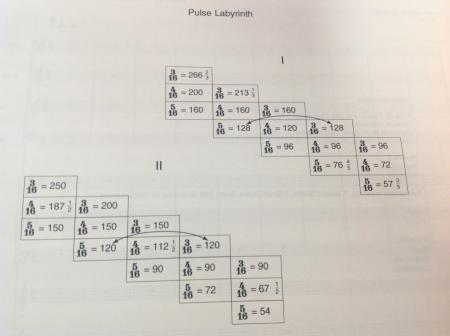
This activity will explore the idea of rhythmic planes moving at different speeds simultaneously. Birtwistle also gives precise articulations and dynamics which range from pppp (very quiet) con sord (with mute) to ffff staccato accented.
Organise pupils into instrumental groups (not the threes they have been previously working in) and nominate a conductor for each group. Ask each group to choose a note they can all play from the original pitch range you choose. Firstly ask them to practice holding a steady pulse, on the chosen pitch, given by the conductor. They should then try this at different tempos. The conductor should count them in at the desired tempo and keep indicating the tempo until they stop the group. Once they feel confident with this they could practice different articulations and dynamics, changing each time they stop and start. Ask the groups to develop signals so that the group knows what articulation and dynamic to play each time.
Create a whole group piece with groups starting and stopping in their own time, coming in at their own tempo and with their own dynamics and articulations.
Listen to BCMG musicians playing some 'rhythmic planes'.
As a class you now have:
Ask the groups of threes to plan and practice a complete composition by structuring their three favourite versions of the musical object. Remember different musical objects can repeat, form ostinatos and overlap. As they do this, ask the groups to:
Perform the compositions. If you would like to, you can add the rhythmic plane music in between each groups 'piece' to create a class composition.
Afterwards, ask the class to think about and discuss what works and what doesn’t. They may want to refine their ideas based on what they have heard.
Listen to the version created by children at our Music Maze workshop.

Tel: +44 (0)121 616 2616
Birmingham Contemporary
Music Group
CBSO Centre
Berkley Street
Birmingham
B1 2LF
BCMG is registered in England no: 2446126
Registered charity no: 1001474
VAT reg. no. GB 614 418 655
© Birmingham Contemporary Music Group 2026